Last spring, we presented Building a Reading Culture at the MCTE annual conference because we wanted to share our passion for fostering a love of reading with our students and because we felt like we had a few tips, tricks, and ideas that might come in handy for other teachers. However, we learned just as much by presenting and connecting with fellow English teachers about the ongoing process and dynamic nature of building a reading culture.

Jon Gordon explains culture as the “living, breathing, essence of what an organization values, believes, thinks, says and does.” He goes on to acknowledge that “culture is not one person. It’s everyone. Culture is not static. It’s dynamic.” Ironically, it was following our presentation and in the valuable conversations with English teachers from across the state about how we’ve built our reading culture that we fully realized that’s exactly what we’ve done—built something that’s rooted in a shared passion for literacy—and that in order for that culture to continue to grow and evolve, that value for reading needs to be intentionally woven into the fabric of our English classrooms and our curriculum.
Our passion is big and our love of books is a borderline addiction, so we’re going to hold ourselves back and offer some bite-size pieces of our work in building a reading culture. In the ideas that follow, you’ll learn more about how we introduce books to students and begin to give them time with stories in ways that hook them and set them up to experience reading success; at the 2024 MCTE conference, we’ll offer another look at building a reading culture as we present on literature circles and choice book clubs.
It is imperative that we recommend and model reading habits to our students to build a reading culture. As Jocko Willink with Jordan B. Peterson explains in the podcast episode “Literacy and Strength,” reading is an investment of time, so most people read books that have been recommended to them. These are our favorite strategies for recommending books to our students so that they invest their time in reading and talking about reading.
Book Talks
A favorite and convenient way to introduce books to students is to share a Book Talk! A Book Talk can be as simple as holding a book up in front of our students, telling them the title, author, genre, a little bit about the characters and plot, and why they should read it.
Book Talks are often spontaneous; we share what we’ve read recently, our favorites, new additions to our class libraries, and student recommendations. Sometimes it takes three minutes, or we can get creative with ten. Oftentimes, students will ask questions about the content or connections to history or our world, and this helps develop their background knowledge, as encouraged by Natalie Wexler’s The Knowledge Gap.
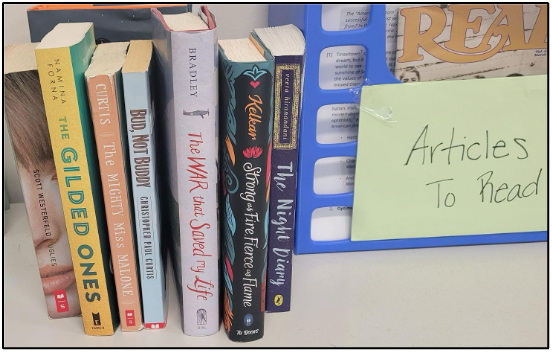
An example of a creative Book Talk was when teaching a creative writing class, we had a box of recent award-winning books delivered to choose a novel as model text, and rather than opening the box ahead of time, I brought it into class and had a student record our box opening for a social media reel. They enjoyed coaching me, and we built anticipation over these new books.
After sharing a Book Talk, it’s important to display the books and to make them easily accessible to students to browse and even check out to read.
There are several academic benefits to Book Talks: exposing students to a variety of literature, modeling how to summarize and concisely present ideas, and building background knowledge. These justify Book Talks as part of our instructional time.
First Chapter Fridays
We can’t take credit for coming up with this idea, but we have found First Chapters Fridays to be a manageable way of sharing books with kids and a successful means of hooking them into the story enough that they continue to read! We most consistently incorporate First Chapter Fridays as part of the 7th grade English curriculum by highlighting a new book every Friday and then reading the first chapter aloud to the class. It’s been a point of emphasis to feature a variety of books for our Friday picks—graphic novels, fiction and nonfiction, audio books, diverse books, and a variety of authors. And, more Fridays than not, we have multiple students asking to check out our First Chapter Friday book of the week!

Additionally, this has been a good opportunity to meet our avid readers and high flyers where they’re at, as these students are often ahead in their reading or finish an assigned class novel ahead of the group, so we make a point of sharing books that are written by the current author we’re studying, a sequel to the current novel we’re reading, or go along with the topic we learning about as a means of extending their learning.
Don’t teach 7th grade English? This is easily an idea that can be adjusted to other grade levels and content areas, maybe through a “Turn The Page Tuesday” or “What I’m Reading Wednesday” where you simply share with students a good book you’re enjoying, by highlighting a children’s book author each week, or by featuring some texts that go along with what students are learning about in social studies, science, or other subjects.
You can also check out The Spark Creativity Teacher’s podcast episode “The Ultimate Guide to First Chapter Friday” for ideas.
Window Displays
An important part of building a reading culture is to encourage both staff and students to have conversations about what they’re reading. A simple way to authentically engage in these is to display what you’re currently reading and listening to on your door or whiteboard for others to see.

This is a way that we can model our reading “diet” to our students even when it’s not related to our curriculum or even our content-areas. These displays give students and staff members a connection, a talking point, to build shared interests and find book recommendations.
Some helpful tips are to keep your display simple and manageable; you’ll want to be able to change it frequently and easily so that you actually keep up with it. One way to do this is to keep a simple sheet of paper in a page protector and use a dry erase maker or have a page taped to a window and use a dry erase marker on the glass side. You can also make an interactive whiteboard where you have your current reading list and invite students to share their reading on it as well.
Other fun ideas include adding a “What I’m Reading” as an email tag or asking a student aid to create a book display in or outside of the classroom. There are lots of fun ideas to inspire you on Google too!
Menus (Book Tastings)
Providing students with a menu of options is a way to teach students how to preview physical books. One day, we hope that our life-long learners will visit libraries or bookstores and feel confident in choosing a book that interests them. Menus provided in a classroom activity often known as a Book Tasting allows us to demonstrate and have our students practice choosing books.
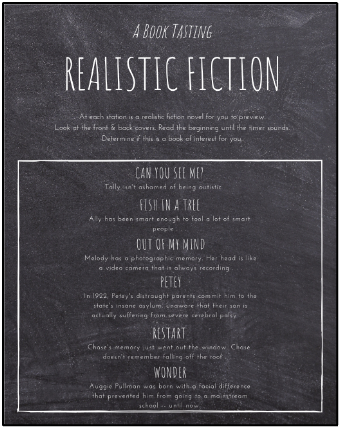
We create our menus that we print out for students on Canva with a short description of the book, and these are left on tables alongside physical copies of the book. We demonstrate to our students the process of previewing a book: Check out the front and back covers, read the synopsis, skim through the book to check out the font, chapter lengths, and begin reading the first chapter. To discourage students from rushing from each table, we set a timer and also require students to visit each table. At the end of the rotation, we then give students additional time to revisit any of the books to help them decide their Top Three choices.

Using a menu is particularly helpful when we want to organize students into groups for books clubs or literature circles. You can also use Book Tastings when you want students to complete an individual project. One way we like to do this is by laying a variety of books out on tables organized by genre or topics that may appeal to our students.
Digital Menus
Our students aren’t limited to reading physical books; many of them have access to digital versions or online information about books. We like to occasionally offer our students a digital menu to preview books. This prepares our students to research online and preview texts that they can apply to their lives if they order books online or use an app from the local library to read or listen to books.
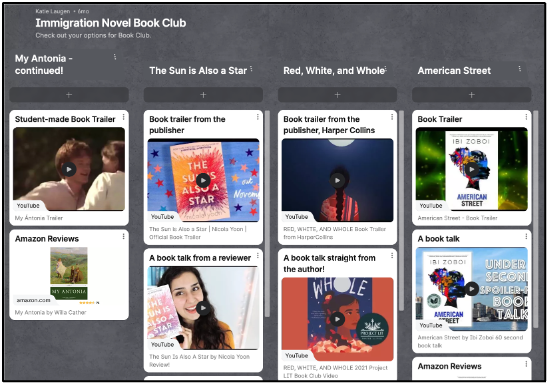
We prepare our digital menus using Padlet and use them to introduce book options for thematic book clubs or literature circles. To prepare one, we try to include professional book trailers (or student-made if the publisher doesn’t provide one), a video of a book talk review, and a link to either Amazon or Goodreads reviews. We may also include a physical display in our classrooms when we ask students for their top choices so they can preview the texts as we’ve previously taught them.
Library Field Trips
Don’t take for granted the value of a simple field trip to the local library! Another avenue we’ve used for introducing students to books is through a visit to our community’s public library. For us it’s a walkable trip that can be completed within a class period, but it also gets kids outside and is a fun break from our normal routines.
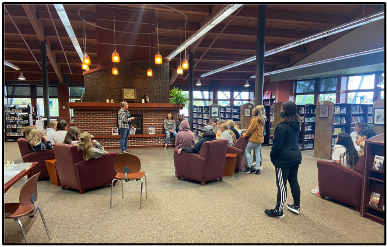
We coordinate with our wonderful community librarian to help make sure every student has an up-to-date library card and that they hear about all of the resources and events the library offers teenagers beyond just the obvious books. Students hear about the free wifi, comfortable places to hangout and work, special events geared just for teenagers and young adult literature, access to computers and printers, digital and audio book options, and of course the snacks and hot chocolate.
If logistically a quick field trip to the community library isn’t feasible, we’d say the same thing about embracing a visit to your own school’s library or book room and getting teenagers reacquainted with a place they maybe haven’t frequented since elementary school. In the primary school years, library time is often built into the schedule and children are explicitly taught how to both behave in the library and navigate to the children’s books section. An in-house field trip holds the potential to introduce students to an area of the library that was maybe off limits in their earlier years, or if a move to secondary school involved moving to a new building, this type of “field trip” provides the opportunity for introductions of staff, the space, the behavior expectations, and the programming available. Secondary libraries often function as more of a media center and meeting place; if your school librarian isn’t already doing so, we’d encourage you to work together with them to add simple things like adult coloring sheets, board games, and puzzles. Sometimes students will gravitate to the library for these activities and end up stumbling on a book that catches their eye—it’s a win-win!
In the end, the goal is that any assumptions teenagers might have about the library being a quiet, unwelcoming space are broken down, and instead students are invited to another space in our community or the school to lean into the love of reading.
Conclusion
We don’t have to tell you, teaching English is a big job, with more than enough content and standards to cover, and way more than enough papers to correct and reading to keep up on that follows you home. We also know that it’s vitally important to give protected and intentional time to the skills and experiences that are most important for our students. For us, we believe that exposing kids to books, sharing our passion for reading, and helping set every student up to be successful in their reading is one of those non-negotiable classroom experiences. So we give it time, we pour into it authentically by sharing our personal experiences as readers, and we nurture those flames of interest in our students when they find something that builds their love of reading. And then, hopefully, that passion becomes contagious, extending across the school, and you get a few minutes at your desk while the kids are nose-deep in their books to catch your breath…and of course, take attendance!
Additional Sources of Our Inspiration
- NBC News’ 2018 article “Why ‘getting lost in a book’ is so good for you, according to science”
- Kids Read Now’s 2018 article “The Benefits of Reading for Pleasure”
- Kylene Beers and Robert Probst’s Disrupting Thinking
- Kelly Gallagher’s works, including Article of the Week
- Kate Roberts’ A Novel Approach
Learn more about the authors on our 2024 Contributors page.
 MEJ
MEJ 