Before reading this article, we encourage readers to think and reflect openly and honestly on the two questions presented below.

Introduction
Knowledge of social studies and the world is crucial for every citizen and thus should be an essential component within schools. In recent years, there has been a notable decline in elementary content area instruction, resulting in limited student opportunities to develop background knowledge in subjects like science and social studies. Background knowledge is a critical component of reading comprehension, particularly when students need to draw upon it for content area reading and making inferences. Recognizing this, integrating social studies through read-aloud lessons emerges as a powerful strategy to simultaneously enhance students’ literacy skills and provide essential background knowledge in social studies content.
The purpose of this manuscript is to revisit the positive benefits of the read-aloud as an inquiry tool for social studies and language arts integration. First, we will highlight the importance and value of the read-aloud. Next, we will discuss the importance of teaching and integrating social studies. This is followed by an overview of the notable trade books of the National Council for Social Studies (NCSS), which are valuable tools for teachers looking to integrate social studies and language arts. The manuscript concludes by emphasizing a selection of recommended texts. These dynamic texts are specifically curated to address social studies, characterized by their exceptional quality, ensuring a compelling engagement for learners. In addition, we share lesson seeds to guide teachers’ work utilizing these texts with a read-aloud.
Read-Alouds: What, How, Why?
The act of reading aloud plays a pivotal role not only in fostering a lifelong interest in reading but also in significantly contributing to academic achievement. Multiple literacy experts and studies highlight that reading to children from a very young age is crucial in developing a positive attitude towards reading, predicting improvements in reading motivation. Notably, children exposed to daily reading experiences enter kindergarten with exposure to around 1.4 million more words than those not read to, a phenomenon known as the “million-word gap,” which significantly influences vocabulary and reading development. Kids who hear more vocabulary words are better prepared to see those words in print when encountered in print.
Beyond motivation, read-aloud sessions have been consistently linked to improved academic outcomes. Early exposure to read-alouds correlates with enhanced vocabulary, comprehension, fluency, and overall language development. These skills make up the oft-forgotten language comprehension strand within The Reading Rope that helps readers make meaning from the text. While the Science of Reading movement emphasizes the word recognition strand, language comprehension strands are equally vital. As students engage in read-aloud sessions, they not only develop a love for reading but also acquire essential skills and knowledge that extend beyond literature into various content areas, including social studies and science.
During reading, teachers can create opportunities for engagement by incorporating read-aloud sessions coupled with extension activities relevant to the text, which enhances comprehension. Such activities, whether conducted before, during, or after the read-aloud, help students connect or extend their prior knowledge by fostering proficiency in both reading and critical thinking. Fitzgerald offers guidance on how to engage readers before, during, and after the read-aloud. Before reading, it is suggested to engage readers by outlining the lesson’s purpose, asking relevant questions, and providing a preview without revealing too much. During reading, teachers are encouraged to model strategic reading behaviors, employ think-alouds to verbalize thoughts, and pose interactive questions. After reading, meaningful conversations about the text’s overall meaning, reflections on surprises and acquired knowledge, and extensions of learning are recommended, creating a comprehensive approach to literacy instruction that spans the entire reading experience.
Social Studies: What, How, and Why?
The NCSS states “the primary purpose of social studies is to help young people develop the ability to make informed and reasoned decisions for the public good as citizens of a culturally diverse, democratic society in an interdependent world.” With this ambitious purpose, how is social studies addressed in classrooms? It has been recommended that elementary teachers dedicate a daily block of time to social studies instruction. Despite such recommendations, there has been a historical trend, noted as early as the 1970s, to deprioritize social studies education. This de-prioritization is evident in the limited social studies instruction occurring as more instructional time is devoted to tested and/or trending topics. With this deprioritization, it is important for educators to consider integrating social studies within English language arts space to creatively address increasing social studies instruction.
The NCSS identified ten thematic strands of social studies. These represent strands that social studies instruction should be inclusive of. The strands include:
- Culture
- Time, Continuity, and Change
- People, Places, and Environments
- Individual Development and Identity
- Individuals, Groups, and Institutions
- Power, Authority, and Governance
- Production, Distribution, and Consumption
- Science, Technology, and Society
- Global Connections
- Civic Ideals and Practices
Within social studies, the C3 framework presents opportunities for enhanced and improved social studies instruction that addresses the 10 thematic strands while integrating inquiry. More specifically, the four dimensions provide a clear direction for thinking about social studies in unique ways while ensuring the instruction is meaningful and purposeful. These dimensions provide opportunities to engage learners in content through developing questions, analyzing, and evaluating content, and communicating conclusions. Social studies has had a historical emphasis on literacy, and each of these dimensions are natural ways to integrate social studies and English language arts skills that provide an academic benefit to both areas.
NCSS Notable Trade Books: What, How, and Why?
The NCSS notable trade books are a yearly published annotated list of social studies books that have been published within the previous calendar year. A committee has reviewed these books and determined that they are exceptional and recommends use to address the social studies thematic strands. These books generally emphasize human relations, diverse groups, and a range of cultural experiences. The list also provides classroom teachers with texts that explore interesting topics in unique formats, and present opportunities for student engagement and discussion. More specifically, these texts allow teachers to tap into and build students’ schema, make personal connections with the social studies content, and engage students in difficult topics using texts students will enjoy.
We believe the integration of notable social studies trade books provides an opportunity for teachers to integrate specific literacy strategies that can help develop social studies content knowledge. These strategies should include building prior knowledge, building vocabulary, posing questions, comparing, and evaluating claims and evidence. In addition to these, the NCSS also has noted several literacy skills which are beneficial for learners before, during, and after reading. These include making predictions, developing questions, generating representations, using graphic organizers, summarizing, and making comparisons. The read-aloud presents opportunities for classroom teachers to model and engage students with these strategies while also integrating social studies content. These strategies will help to build content knowledge in addition to the skills successful readers use when reading texts.
Furthermore, utilizing read-alouds of notable trade books present multiple opportunities for students. They get rich opportunities to question content, identify new knowledge, and share learned information with others. These read-alouds also serve as a dynamic space for making sense of complex issues, learning about diversity, developing student discourse skills, and connecting students’ experiences to the broader world. To this point, a study conducted by Wee & Lehman found that by intentionally guiding students during read-alouds to explore global settings, unique experiences, and cultures, educators can amplify the impact of literature in fostering critical thinking, global awareness, and a deeper understanding of social studies concepts. Thus, read-alouds emerge as a potent tool for seamlessly integrating social studies into the curriculum while addressing the time constraints associated with instruction within this critical subject.
Selecting Texts for Integration
Here, we offer four recommendations when selecting texts for integration. First, it is crucial for teachers to thoroughly read every text intended for instruction. External recommendations are valuable, but a teacher should possess a solid understanding of the content before incorporating the text into lessons. Second, it is important to emphasize the integration of social studies-focused texts not only in elementary settings, but across all grades, from K-12. As noted earlier, this integration of social studies content provides opportunities for meaningful discussions, engagement, and connections for students. Third, seek recommendations from reliable sources such as the NCSS notable trade book list, book award lists such as the NCTE Charlotte Huck Book Award, the Orbis Pictus Award, book reviewer suggestions, colleagues, or those highlighted by reputable publishers. Last, consider the criteria for a good children’s and adolescent book. The text should expand awareness, offer an enjoyable yet subtle educational experience, convey truth, possess good literary qualities, demonstrate integrity, exhibit originality, and stimulate the reader’s mind.
Recommended Texts and Lesson Seeds
In this section, teachers will find six 2023 notable trade books we recommend as great texts to integrate Social Studies within ELA spaces across grades K-8. The six recommended texts are Home, Blue, My Nest of Silence, My Bindi, New from Here, and Alias Anna. Each is presented with the suggested grade levels, social studies themes addressed, potential unit ideas, and a simplistic text summary. Following this information, teachers will find a lesson seed that provides instructional support for integrating the text. It is important to note that these texts and seeds are suggestions for teachers to address the integration of social studies within literacy spaces. Each text and lesson seed allows teachers to mold their students into well-rounded, informed citizens through questions and engagement with high-quality literature. Each seed features before, during, and after-reading questions that follow the guidelines outlined by Fitzgerald, stated earlier. Our aim with these questions is to facilitate teachers’ creation of learning opportunities tied to the ten thematic strands. We strongly encourage teachers to adapt the questions to suit their specific learning objectives and grade-level standards.

Before-Reading Options:
- Questions: What does HOME mean to you? Where is your home? Who is a part of your home? Can your home change? What things make a home for you?
- Vocabulary: Rent, mortgage, houseless
- Read to determine how a home can change for people.
During-Reading Question:
- Page with brown house: How would you describe Clare and Wes?
- Page with nowhere: THINK ALOUD—The text says the family lives nowhere. Hmmmm, I think to myself, are they really living nowhere? Can anyone live nowhere? No. From the pictures, I can see they live with others and in different places. Sometimes, families need to do this to live.
- In line page: From nowhere to somewhere. The family is now making a home at a shelter. A shelter is where people can stay and keep themselves safe before moving to a different place. This place usually has many other people and families.
- Page with leaves: The leaves changed colors, and they went to school. What can we infer here?
- Page at the school: If Wes and Clare were in our class, how would we treat them?
- Page at home with the light shining: What do you think Clare and Wes would say for us to do when things are hard?
After-Reading Activity:
- Discussion about illustrations. Some in bright colors with others mostly black and white? Why do you think this is?
- Graphic organizers: Bubble map noting the feelings of Wes and Clare throughout the text, Story map noting characters and the different settings, compare and contrast the lived experience of Clare/Wes with your own.

Before-Reading Options:
- Class discussion: What are some things that are blue? What do you know about the color blue? What does blue symbolize for you?
- Vocabulary review: “BC”, Cultural Groups (consider showing visuals to build background with these) -> Egyptians, Phoenician,
- Set purpose for reading: Option→ to find the historical roots, benefits, and uses of the color blue.
During-Reading Questions:
- Blue page with hands and water: It’s in the sea, but when you cup it, it disappears…. Let’s think about that line. Hmmm I don’t think I have ever thought about that before. Turn/talk to share your thoughts about this line.
- 4500 BC pages: How did ancient Egyptians find and acquire the blue rocks? Do you think these rocks had high value? Why do you think that?
- Green page with hand: Snail blue was hard to produce. What made it hard to produce? How might this process be sped up?
- Green page with blue can: Here we have another source of blue. What are the sources so far? Which do you believe to be the easiest and hardest to acquire? Why?
- Blue eye dropper: People used blue like money—what is another term that could be used here?
- Next page with folks in field: What word could we use to describe these leaders/people references here? Why you use that term? What historical events lead you to think this? (table discussions)
- Kids playing: Blue is more than color, its a feeling… Let’s break this down. What does this mean? What is an example?
After-Reading Activity:
- Read the author’s note with the class.
- Potential activity and questions around analyzing the Informational text structure (description)
- Blue has such a long and rich history. Create a graphic organizer that represents the historical details and the benefits for the color blue.
- Blue had many influences on its development and popularity across multiple locations. Generate a written response that notes the influences on its development and use.

Before-Reading Options:
- Build Background:
- This text deals with World War II, more specifically with the perspective of Japanese Americans and discrimination. Students need a basic knowledge of this. Maybe video clips and discussions.
- Display the introductory graphic pages. Discuss the relationship between the two.
- Share video clips or reference previous readings related to the content.
- Vocabulary: Barracks
During-Reading Question:
Ch 1
- Identity: Within this first chapter, there are multiple identities presented. Discuss the identities with students, questions about how they impact the overall student.
- Power: What are the power roles of the individual in the text? Who has the power? What does power look like?
- People/Choices: Have students explore Makoto’s decision to join the army. Evaluate his decision’s positive and negative benefits. How does his decision impact others in his family? (This can be referenced in several chapters)
Ch 2
- Voice: Voice does not always relate to sound. What is the role of voice for identity and culture? Is silence the right choice? What might be the impacts of this to the family?
Ch. 3
- Mak perspective and interactions are represented via graphics. Why?
- What do we know about Mak and his experiences? Is this the army or service experience of traditional soldiers?
Ch. 4
- The lived experience here is challenging. The author includes specific challenges that are representative of the time period and the authority being placed over the individuals. Discuss the relationship of the challenges to the individuals.
After-Reading Activity:
- An exploration of locations within the text. How do those locations impact the overall lives of the main family?
- Relationships are important. Explain the connections between various characters (individuals) within the text. How do they impact or interact with others?
- Given the contextual elements of the time, how are cultures represented and repressed?
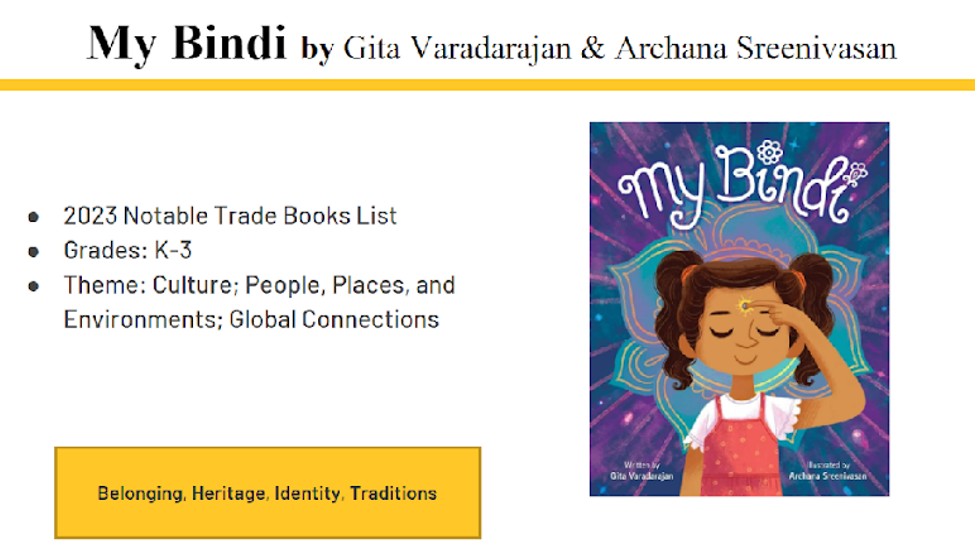
Before-Reading Options:
- Exploring personal identities: Introduce the concept of personal identity to students and discuss how individuals express their unique selves. Ask students to share aspects of their identities that are important to them (e.g., cultural background, traditions, hobbies). Discuss the idea of bringing one’s “authentic self” to different environments, such as school.
During-Reading Questions:
- Illustration interpretation: Encourage students to pay attention to the illustrations and how they complement the narrative. Discuss how the illustrations capture the essence of Divya’s family and their diverse identities.
After-Reading Activities:
- Authentic self collage: Have students create a collage that represents their authentic selves. They can include images, drawings, or words that showcase different aspects of their identity. Encourage students to share their collages with the class and explain the significance of each element.
- Cultural exchange day: Organize a “Cultural Exchange Day” where students can share aspects of their cultural identity. This could involve presentations, traditional clothing, or sharing cultural artifacts. Discuss the importance of appreciating and respecting diverse identities within the classroom.

Before-Reading Options:
- Predicting Knox’s challenges: Before starting the book, discuss what challenges you think Knox might face as a result of moving to a new country. Consider how the family’s background might impact their experiences.
During-Read Questions:
- Sibling dynamics: Track and discuss the dynamics among Knox and his siblings as the story unfolds. Examine how they cope with challenges, discrimination, and being the new kids in school. Consider moments where you can relate to or empathize with their experiences.
- Exploring anti-Asian discrimination: Identify parts of the book where anti-Asian discrimination is evident. Explore how such discrimination affects their sense of identity, belonging, and the choices they make. Consider how the characters respond to acts of discrimination.
After-Reading Activities:
- Pandemic reflections—1918 vs. COVID-19: Divide the students into groups and assign each group a specific aspect to research, such as public health measures, discrimination, or lessons learned. Have each group present their findings, comparing the 1918 Influenza pandemic with the COVID-19 pandemic. Discuss as a class the relevance of historical lessons in addressing current global challenges.
- Understanding ADHD: Research and discuss ADHD as a group. Share your findings on how ADHD might influence Knox’s character and actions. Consider how this might play a role in his relationships and experiences throughout the story.
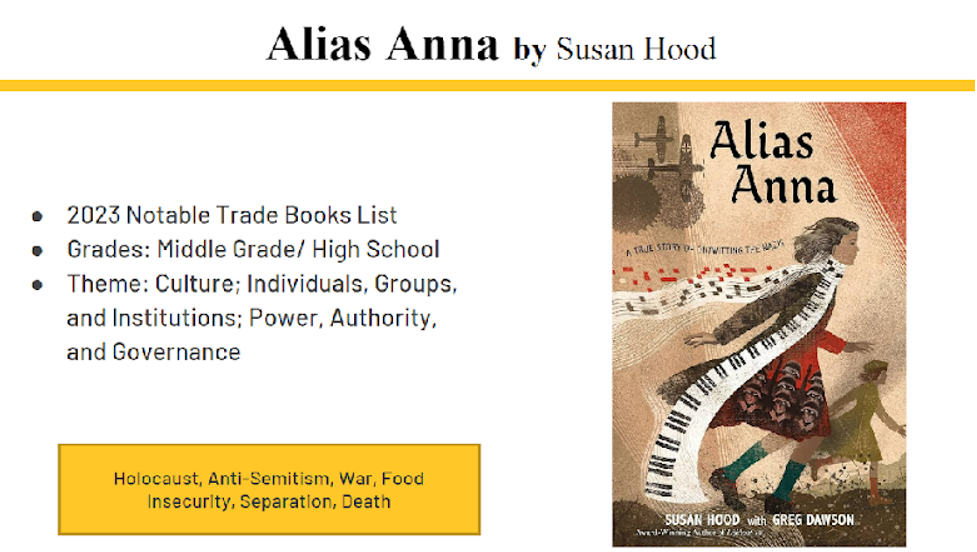
Before-Reading Options:
- Exploring personal identity: Discuss the concept of personal identity and the importance of one’s name in shaping it. Encourage students to share their thoughts on what comprises a person’s identity. Ask students to reflect on a time when they had to hide a part of their identity or use an alias.
- Understanding free verse: Introduce the concept of free verse and discuss its characteristics. Explore different poetic forms mentioned in the book, such as haiku and concrete poetry. Have students discuss their preferences for certain poetic forms and how they enhance the storytelling.
During-Reading Questions:
- Musical terms and symbolism: Examine the organization of the book into musical terms and discuss their definitions. Explore how each musical term represents or symbolizes events and themes in that part of the story. Encourage students to share their interpretations of the symbolism.
- Musical prodigies and foreshadowing: Analyze the scene where Zhanna performs in total darkness and its foreshadowing of future events. Explore how Zhanna’s ability to proceed in the dark serves as a metaphor for her resilience.
- Sisterly connection: Discuss the scene where Frina lies down in the snow and refuses to go on. Explore the trauma experienced by Frina during the death march and its implicit presence in the scene. Identify other moments in the book that highlight the strong sisterly connection between Zhanna and Frina.
After-Reading Activities:
- Letters to elders: Encourage students to write letters to their grandparents or elder relatives, inquiring about their lives as teenagers. Inspire students to ask specific questions, fostering a connection between generations. Introduce students to StoryCorps for guidance on conducting oral history interviews.
- Understanding refugee experiences: Lead a discussion on what it means to be a refugee using Zhanna’s school transformation into a refugee center as a starting point. Explore the current global refugee crises, encouraging students to research and report back to the class. Discuss the challenges faced by refugees and ways to support displaced populations.
- Classical music exploration: Introduce students to classical musicians referenced in “Alias Anna,” such as Bach, Bizet, Brahms, Beethoven, Chopin, Rossini, and Tchaikovsky. Play excerpts from their compositions and discuss the emotional impact. Consider a field trip to view a local symphony orchestra, opera, or other musical performance.
A Call to Action
In conclusion, the intentional integration of social studies and language arts through carefully selected read-alouds is paramount for cultivating well-rounded, informed citizens. This manuscript underscores the pivotal role of read-alouds in fostering a love for reading, improving academic outcomes, and addressing the historical deprioritization of social studies in education. The NCSS notable trade books emerge as catalysts, aligning with thematic strands and providing engaging narratives that bridge content areas. We encourage educators to prioritize the selection of texts that expand awareness, tell the truth, and stretch students’ minds. The recommended six notable texts, accompanied by lesson seeds, offer practical avenues for seamlessly integrating social studies within ELA spaces. As educators continue to navigate the educational landscape, we place a call to act by recognizing the transformative potential of read-alouds by weaving the intricate threads of Social Studies into the educational fabric, fostering critical thinking, and nurturing a curiosity for lifelong learning.
Additional Notable Trade Book Recommendations
- Milo Imagines the World by Matt de la Peña
- Global by Eoin Colfer *anticipated*
- Hoops by Matt Tavares *anticipated*
- The Cricket War by Tho Pham and Sandra McTavish
- Miss Pinkeltink’s Purse by Patty Brozo and Ana Ochoa
- Freewater by Amina Luqman-Dawson
- Santiago’s Road Home by Alexandra Diaz
- We are still here! Native American Truths Everyone Should Know by Traci Sorrell
- Box: Henry Brown Mails Himself to Freedom by Carole Boston Weatherford
- Maya’s Song by Renée Watson
- Something Happened to My Dad: A Story about Immigration and Family Separation by Ann Hazzard and Vivianne Aponte Rivera
- The Talk by Alicia D. Williams
- Mascot by Charles Waters and Traci Sorell *anticipated*
** Many titles can also be found on Epic.
Works Cited
Baker, Doris L. et al. “Effects of a Read Aloud Intervention on First Grade Student Vocabulary, Listening Comprehension, and Language Proficiency.” Reading and Writing, An Interdisciplinary Journal, 2020.
Barrentine, Shelby J. “Engaging with Reading Through Interactive Read-Alouds.” The Reading Teacher, vol. 50, no. 1, 1996, pp. 36-43.
Britt, Judy, & Howe, Mandi. “Developing a vision for the common core classroom: what does elementary social studies look like?.” The Social Studies 105.3 (2014): 158-163.
Dwyer, Meredyth, & Martin‐Chang, Sandra. “Fact from Fiction: The Learning Benefits of Listening to Historical Fiction.” The Reading Teacher, 2023.
Hartsfield, Danielle E., & Kimmel, Sue C. Genre-based strategies to promote critical literacy in grades 4–8. Bloomsbury Publishing USA, 2019.
Heafner, Tina, & Fitchett, Paul. “National Trends in Elementary Instruction: Exploring the Role of Social Studies Curricula.” Social Studies, vol. 103, no. 2, 2012, pp. 67-72.
Hwang, Hyejin, & Duke, Nell. “Content Counts and Motivation Matters: Reading Comprehension in Third-Grade Students Who Are English Learners.” AERA Open, vol. 6, no. 1, 2020.
Klesius, Janell P., & Griffith, Priscilla L. “Interactive Storybook Reading for At-Risk Learners.” The Reading Teacher, vol. 49, no. 7, 1996, pp. 552-560.
Lee, Carol D., & Spratley, Anika. Reading in the Disciplines: The Challenges of Adolescent Literacy. New York, NY: Carnegie Corporation of New York, 2010.
Logan, Jessica A. R. et al. “When Children Are Not Read to at Home: The Million Word Gap.” Journal of Developmental & Behavioral Pediatrics, vol. 40, no. 5, 2019, pp. 383-386.
McCormick, Sandra. “Should You Read Aloud to Your Children?” Language Arts, vol. 54, no. 2, 1977, pp. 139-143.
Mol, Suzanne E., & Bus, Adriana G. “To Read or Not to Read: A Meta-Analysis of Print Exposure from Infancy to Early Adulthood.” Psychological Bulletin, vol. 137, no. 2, 2011, pp. 267–296.
National Council for the Social Studies. “National Curriculum Standards for Social Studies: A Framework for Teaching, Learning and Assessment.” Washington, DC, 2010.
Learn more about the authors on our 2024 Contributors page.
 MEJ
MEJ 