Thank you to the attending circle for sitting in community with us last spring. Thanks to MCTE for the welcome and thanks to Burke and Lee for the invitation to write. Special gratitude to Ricardo Levins Morales https://www.rlmartstudio.com/ for how your movement ideas and art hold us up and push us together in thoughtful ways. Thanks to many more who have sat in community with us for years past and years ahead, to students and families and colleagues and friends. ❤ -alison and abby
Sitting in Community: A Circle of Secondary ELA Teachers
On a crisp spring afternoon, a group of 25 educators gathered together to sit in circle. It was day one of the 2024 MCTE conference in Duluth, MN, in Onigamiising, land of the small portage.
For our workshop, Sitting in Community: A Circle of Secondary ELA/Literacy Teachers and Advocates, we wanted to attend to a very specific problem: educators rarely have the opportunity to sit in community. What is true for students is also true for teachers: we need safe spaces to be our true selves. We need space without hierarchy or school politics. We need space that affirms our experience and expertise. We need spaces where we can find common ground and where we can also disagree. We live as teachers every day without these opportunities, but we can take a break and a breath to find the conversations that need to come out (brown, 2017). We hoped to offer a gentle reminder of what it feels like to be valued and listened to, and to give conference participants dedicated time to connect with each other. In the midst of turbulent times, we needed a space for solidarity.
We also need to practice what we teach: to use circle responsibly, we must know what it feels like to adhere to agreements, to sit and listen deeply, to share our truth. It is helpful to experience the power of circle and the immediate bonds that it can bring. As educators, the two of us have experienced the power of circle with our students many times. We use circle to tell stories, to create kinship, to deepen relationships with each other and with text, to decolonize our classrooms, and to return space to whom it belongs, especially in schools: to students.
We also must thank our Indigenous relatives for circle as worldview, rooted in the sacred hoop of life. We have much to learn from Indigenous ways of knowing, and we offer our gratitude for the teachings of Robin Wall Kimmer (2013) and others (Criss, 2018). There is an importance in practicing circle pedagogy with educators (Currie & Kaminski, 2009). Professional development (PD) sessions too rarely reflect the “best practices” and “student engagement methods” we are expected to use with students. In our experience, most PD is sitting and listening and maybe taking notes. In the same way that young people are often talked at, so are teachers. Through this top-down teaching practice, educators and students alike are taught to believe that their ideas and voices have no value (Freire, 1970).
Circle is just as important with adults as with kids, so why is it that we so rarely use it as adults? Is it because it has been used inappropriately or ineffectively? Or because we are uncomfortable with vulnerability? One point of circle can be to connect, including at conferences with people who are not our everyday colleagues. Another key point is to ground us in an experience, to practice being with each other in supportive ways, in order to use that same practice with youth who need it even more and get it even less.
For this manuscript, we trace the structure of our circle from that spring day at MCTE, adding how stories and theories ground us and drive us to be human with our students and our colleagues alike. We hope this offers readers a chance to find new or existing communities to sit with, to find the conversations that are most needed, and to have the courage to create the change that our students demand.
Alison: Circle Agreements
The first thing we did in our session was review six agreements, which I compiled from various circle trainings:
- Respect the talking piece
- Speak from the heart
- Listen from the heart
- No need to rehearse
- Remain in circle
- What happens in circle stays in circle (stories stay and lessons leave)
I’ve held circle with high schoolers and middle schoolers for many years, and I learned quickly that the talking piece matters. It’s more than just a placeholder or decider of who may speak. Bring something meaningful to you, something that carries a story itself, and it will be given respect as an extension of you.
For this circle, I brought a large, brown crystal which was given to me as a gift by a coworker. This became a talking piece with my middle schoolers because it had personal meaning to me (it was a special gift, and I love rocks and crystals) and it also symbolized what I know circle can be. Our introduction to the talking piece and agreements goes something like this:
“Who knows what this is?” I hold up the crystal.
“A rock!” “A crystal!” “A geode!”
“And what makes a geode so special?”
“You don’t know what’s inside unless you crack it open”
“Each one of you has something beautiful inside of you, and we can’t always see it. It is my hope that today in circle we can start to crack ourselves open and allow others to see who we are. This happens when we speak from the heart. And to do this, to trust each other, we have to listen with our hearts too. What do you think this means?”
Number four—no need to rehearse—always trips me up. As an introvert, I often find myself getting anxious as the talking piece gets closer to me. I stop listening to others so I can practice what I’m going to say. When we gift ourselves the norm “No need to rehearse,” we begin to trust ourselves enough to know that when it’s our turn, we will say what is needed. Sometimes students encourage each other to “speak in draft form” because we are not fully finished, in thinking or in speaking. This is speaking from the heart, and it allows us to honor those around us by giving them our full attention. We ask participants to remain in circle, even if we find it challenging; withholding expectations can assist here. Lastly, what happens in circle stays in circle: the personal stories we share stay in this space, while the lessons leave with the listeners.
Welcome and Opening
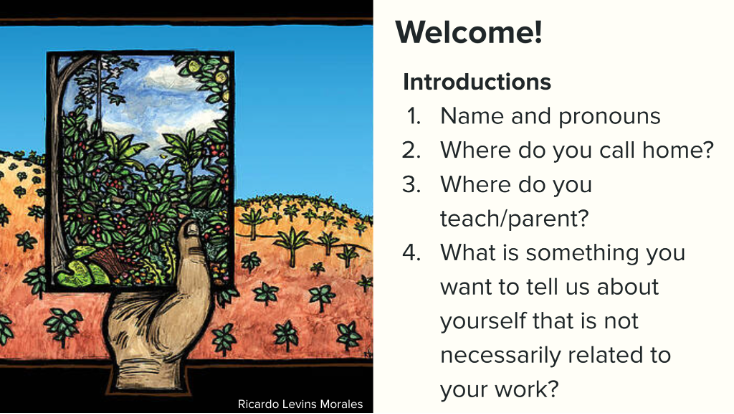
Opener questions allowed us to get to know each other as people outside of our professional roles. We formed connections based on place and history, on hobbies and interests. Our new colleagues in circle, from Minneapolis, St. Paul, and many from greater Minnesota, spoke of family, grandkids, and kids in their twenties. Of gardens, mountains, trees, lakes, oceans, woods, and deserts. Of music, tattoos, and school budget cuts. We started with names and pronouns because you can’t always tell someone’s pronouns by looking at them, and because it is a small signal that all people are welcome.
Grounding in Theory
After our initial introduction, Abby grounded our conversation in ideas about adolescent literacies connected to Culturally Relevant and Sustaining Pedagogies (Alim & Paris, 2017; Ladson-Billings, 1994). Based on our teaching experience, we shared this could include media literacy, communication, ideas, discussion, writing, inquiry, research, reading, vocab, complex text, criticality, joy, text selection, multiple perspectives, and identity. Often, people use the phrase culturally relevant to loosely mean some sort of representation. However, Ladson-Billings and decades of research after her initial study, article, and book, The Dreamkeepers: Successful Teachers of African American Children (1994, 2009) outlines culturally relevant pedagogy in three key ways: growing in cultural competence (of our own and other cultures), raising critical consciousness to challenge the status quo, and experiencing academic success. When Paris and Alim offered their loving critique of Ladson-Billings’s work, they aligned with the commitment to asset-based pedagogies and emphasized the plural nature of youth culture, language, and multilingualism as necessary elements to flourish expectations and learning. Grounding a group in a reading or in critical theories can get us to a deeper level of conversation and understanding, and ultimately, future action.
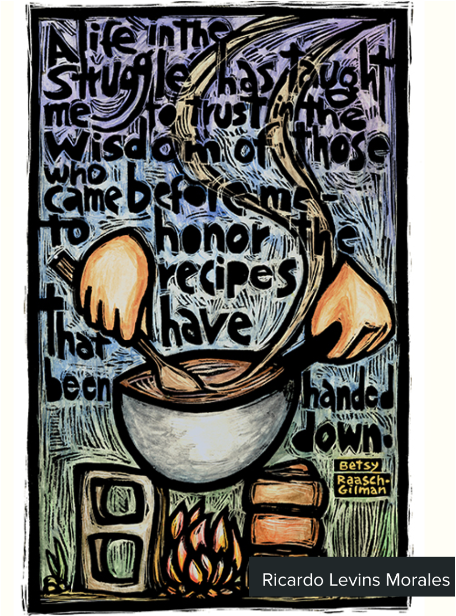
After a brief overview, we asked small groups to discuss: How are these two phrases (culturally relevant and culturally sustaining pedagogies) important for your students? When do they thrive? In this section, we reflect on what those phrases meant for our teaching, struggles, and growth. Here are a few memories about how those theories impacted us.
Alison: Early in my teaching career, I spent a lot of time searching for texts that reflected the cultural identities of my students (Beales, 1995). As a student who never experienced my multiethnic identities represented at school, I wanted to make sure my students experienced this in full. Excerpts from bell hooks’ Feminism is for Everybody, images by Gordon Parks, and DUST’s digital sci-fi series on Afrofuturism honored multimodal literacies and cultural identities. Text selection is incredibly important, but when I attended Augsburg University’s Paideia Seminar training in 2014, I realized that I was given a method on how I could create a classroom culture of learning with students, rather than for students. Paired with the practice of circle and courageous conversations in my classroom, I started to move away from traditional top-down learning structures into more cooperative models.
An introduction to Youth Participatory Action Research (YPAR) challenged me to share power with my students even more. Aiming to rectify centuries of scientific study where marginalized groups are subjects of study, YPAR allows youth to become co-researchers of their own experiences; they then use their research findings to advocate for their communities, becoming valued “agents of positive societal change” (Morales, 2016). Representation became localized, including the lives, neighborhoods, families, languages, skills and interests of those in the room. I specifically remember a mapping exercise we did in class, where students had the opportunity to talk about their home communities and experiences growing up. They talked about how the media portrays our communities and discussed stereotypes. When I put up the Justice Map (justicemap.org) on the board, which uses shades of color to reveal differences in race and income data, students immediately started engaging with the map and sharing their observations. In this case, all I did was honor their intellect, put up a resource that reflected their reality, and ask questions. They were the ones that had a deep and personal conversation that examined structural barriers and intersectionality of race, wealth and income.
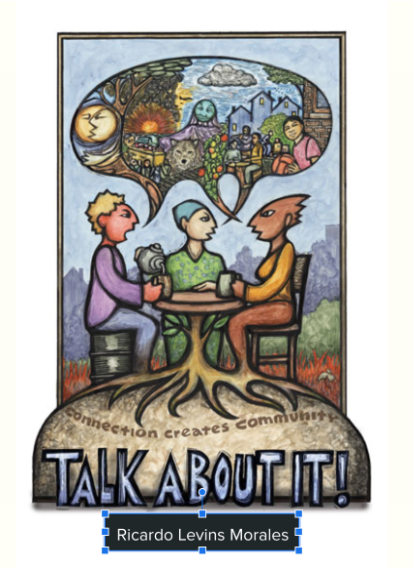
Afterwards, one of my most challenging students stayed after to tell me how much he appreciated class that day, and for the opportunity to talk about where he came from. He felt that many teachers were scared to approach his reality, wanting to ignore it instead. “Not many people want to hear what we have to say. Cuz they don’t like it.”
My students thrived when I started to share power with them in the classroom. Young people need and crave responsibility, and the time and space to share their stories; they do amazing things when we teachers can get our egos–and our mic–out of the way.
Abby: Similar to Alison, I also had a drive to teach representative texts. Being a white woman teacher with predominantly students of color, I felt a responsibility to use ELA class as a way for students to examine the word and the world (Freire & Macedo, 2005), including the worlds of my students (Alim & Paris, 2017). I still use critical multicultural texts (Sleeter, 2024), but when I read and reflected on Ladson-Billings theory on culturally relevant pedagogy in my master’s degree program, her frame gave me more work to do. I felt like my class was doing some of the work she proposed: practicing cultural competence and finding ways to challenge the status quo. However, per her third tenet: Were all of my students experiencing academic success? I could imagine too many students, by name, who were not (yet). I realized there was no point in accepting student work that would not earn student success. So, I started to review papers quickly when students handed in work. I refused to accept a weak response (it was just as easy to read “idk” and ask for a redo right there as it was to accept a paper and have it sit stagnant in a pile for a week (or more) before I read “idk” and then assigned a low grade). I could do more, sooner, for my students.
I remember going back and forth with one 8th grader who I’ll call Amara. She kept handing in a paragraph. I kept handing it back. We exchanged the same paragraph maybe six times before I accepted it. I wasn’t sure if I was doing what was “right”. I knew she was getting frustrated too. I could not engage this practice without us having a solid relationship, without Amara knowing how I believed in her. She didn’t want to write, so she avoided it. I needed to find her motivation (O’Brien, 2006). I also knew her dad was in prison. So instead of the same in-class journal assignments as everyone else, she wrote in a Google doc with entries that we could review, that she could then print at school and send to her dad. In reviewing her writing, I didn’t strip away her languaging (Baker-Bell, 2020); I worked to honor Amara’s ideas, to push her to improve her writing. Prison is an often-ignored cultural norm in the lives of students, but this opportunity let her know that I saw her. (I wish I had the books Missing Daddy or See you Soon (Kaba, 2019; Kaba, 2022) at the time.)
Alongside this experience with Amara, one way that we built relationships in that middle school was through the circle of “student seminar” (Rombalski 2020, 2023), a practice of reading and rereading (Fisher & Frey, 2014) to examine common texts and extend those texts to student lives. Years later, students have reached out to ask if we could hold circle. They valued the practice of circle, of agency, and of learning with each other. Like Alison, I continue to value and use approaches to sharing power, not only as a classroom teacher, but with youth research teams strategizing for change (Rombalski & Gora, in press). Thinking about these theories and stories grounded both of us as we opened a circle for teachers, to talk about our students and our teaching, to sit with each other as humans, to be heard, and to consider our future as ELA teachers in Minnesota in these current times.
Deepening our Conversations and Centering Students
Because our group included over 20 people, we asked participants if they wanted to break into small groups for more time to talk. They decided on groups of three to four, so people turned their chairs to those closest to them, in mini circles. We shared questions that we described as starting places or suggestions. Some groups stuck to them and others followed a different path, but each conversation was heartfelt and reflective, grounded in our circle guidelines. One teacher mentioned how different this approach was compared to what class can be, when it is too prescriptive and “you don’t have to do any thinking.”
It was important for us to ask questions that uplifted young people and their ideas. We wanted to start with assets, to honor worry, and to end with hope:
- What are the brightest lights and the biggest priorities for your students?
- What realities are you facing that are keeping you from those lights and priorities?
- What stories from student experiences do you most want to share here, now, with the people gathered here?
- Where are students finding joy?
- What needs to shift to create more room for what fulfills your students and yourself?
- Share a practice that has worked for you that could work for someone else. What do you want to invite more of, in your life/work?
We loved hearing about the exciting and difficult work we were embarking on collectively. The specific stories will stay in our circle, but we carry the memories of joy and laughter, of honesty and vulnerability, and the reminder that we need more of this, not only for the process, but to determine collective action as well. The pedagogy of circle can help us understand ourselves and one another as well as texts, contexts, issues, and next steps.
After our small group conversations, we came back together in a large circle to reflect and close out.
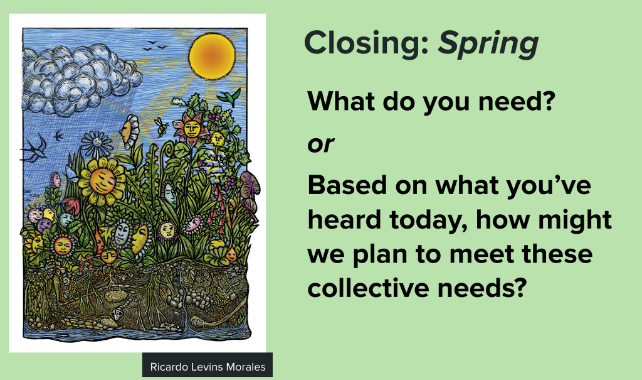
We remember teachers appreciating our time together: “Thank you for preparing this.” “We needed it.” “I can go longer.” They chose to be there and appreciated the time to talk. We provided a space, format, and questions, but as co-creators, they made it what it needed to be. In our closing reflection, we jotted down what they said they needed:
Permission to slow down To go deeper To find joy Time
Book recs Am I doing a good job? To keep going
To celebrate To consider what comes off our plates To connect with creative people
To remember what COVID times gifted us To collaborate
The brief circle we held reflects what is possible on a larger scale. There was a conversation only we could have had, in that moment in time, with those specific people in the room. If we can continue to build on these practices, the positive shifts created in circle will ripple out. In Emergent Strategy, adrienne maree brown (2017) offers insights on how to build change through small shifts:
Small is good, small is all. (The large is a reflection of the small.)
Change is constant. (Be like water.)
There is a conversation in the room that only these people at this moment can have. Find it.
We left those conversations experiencing the possibility of creating a small, new community at a state-based conference. Educationally and politically, we know that our work is not done and that we need one another to support the growth of student-centered classrooms, schools, and communities. We offer these slides, lessons, and questions as a starting place, an opportunity for your own circles and community building. We hope that we can continue to ground each other: in theories, in questions, with young people, in stories, and in circle.
References
Alim, H. S., & Paris, D. (2017). What is culturally sustaining pedagogy and why does it matter. Culturally sustaining pedagogies: Teaching and learning for justice in a changing world, 1(24), 85-101.
Baker-Bell, A. (2020). Dismantling anti-black linguistic racism in English language arts classrooms: Toward an anti-racist black language pedagogy. Theory Into Practice, 59(1), 8-21.
Beals, M. (1995). Warriors Don’t Cry: Searing Memoir of Battle to Integrate Little Rock. Simon and Schuster.
brown, a.m. (2017). Emergent Strategy: Shaping Change, Changing Worlds. AK Press.
Criss, A .What did I learn as an urban high school English teacher about how to begin YPAR from implementing YPAR for the first time? [Masters thesis, Metropolitan State University]. Taskstream. https://w.taskstream.com/ts/programmanager2/MetroState-MS-UrbanEd-Theses
Currie, S., & Kaminski, J. (2009). Talking circles. Retrieved from http://firstnationspedagogy.ca/circletalks.html
Fisher, D., & Frey, N. (2014). Close reading as an intervention for struggling middle school readers. Journal of adolescent & Adult literacy, 57(5), 367-376.
Freire, P. (1970). Pedagogy of the oppressed. Continuum.
Freire, P., & Macedo, D. (2005). Literacy: Reading the word and the world. Routledge.
Kaba, M. (2019). Missing Daddy. Haymarket Books.
Kaba, M. (2022). See you soon. Haymarket Books.
Kimmerer, R. W. (2013). Braiding sweetgrass: Indigenous wisdom, scientific knowledge and the teachings of plants. Milkweed editions.
Ladson-Billings, G. (1994). The dreamkeepers: Successful teachers of African American children. Harvard Educational Review, 64, 488-488.
Ladson-Billings, G. (2022). The dreamkeepers: Successful teachers of African American children. John wiley & sons.
Morales, M. (2016). Participatory Action Research (PAR) cum Action Research (AR) in teacher professional development: A literature review. International Journal of Research, 2 (1), 156-165.
Rombalski, A., & Gora, F.A. (in press.) Auntie Mentors and Strategies for Equity: Leading with Youth Researchers. The High School Journal.
Rombalski, A. (2023). “Resisting Whiteness While Facilitating Discussions in (Socratic) Student Seminars.” In P. Badenhorst, S. Tanner, and J. Grinage (Eds.) Reckoning with the Whiteness of English Education: Transformative Pedagogies in English Language Arts and Beyond. (p. 145-160.) Teachers College Press.
Rombalski, A. (2020). A Quiet Radical Disruption: Dare 2 Listen. In Schmitz, K.C., Cotnam-Kappel, M. and Grant, N. (Eds.) Interrupting, Infiltrating, Investigating: Radical Youth Pedagogy in Education, p. 293-314. DIO Press, New York, NY.
O’Brien, D. (2006). Struggling” adolescents’ engagement in multimediating: Countering the institutional construction of incompetence. Reconceptualizing the literacies in adolescents’ lives, 2, 29-46.
Sleeter, C. E. (2024). Critical multicultural education: Theory and practice. Teachers College Press.
 MEJ
MEJ 