Argumentative writing is a common component of both secondary and postsecondary composition instruction; in the contemporary onslaught of constant information and misinformation from social media and AI, information literacy and the ability to comprehend, construct, and deconstruct arguments is more crucial than ever. Critical thinking that leads to the ability to anticipate needs and concerns and thoughtfully mitigate them is part of an effective argument. An effective argument goes beyond a claim to consider and address counterarguments. The counterargument is just one small piece of this complex genre, yet is a crucial aspect of ensuring a strong and convincing argument.
Writing a counterargument involves possessing a strong understanding of one’s own claims, reasoning, and evidence as well as the ability to anticipate and address the potential perspectives of others. It requires understanding the target audience in order to better tailor the argument to their specific needs. A thoughtfully written counterargument with rebuttal can help the target audience understand the merits of the argument and work through reservations. When applied to real life scenarios, this type of thinking is central to civic life. Far more than simply an English course task, this type of critical thinking and anticipating the priorities of relevant parties is central to success in many professional roles, from government to private sector.
This retrospective case study is the reflection of one instructor on the effectiveness of their practice when teaching argumentative writing. It examines how assumptions about prior knowledge related to counterarguments impact student performance. It describes efforts to support student learning through the use of scaffolds, mentor texts, and the use of AI as a thought partner in perspective taking. It is organized into a case narrative followed by case analysis.
Case Narrative
Context
College A is a two-year college in Minnesota, focusing on culturally affirming education. The school primarily serves roughly 200 local students, of whom 95% are Native American (About 2025). Many students are first generation and/or nontraditional students. Courses are offered in the formats of in person, hybrid/hyflex, online synchronous, and online asynchronous. This case takes place in Composition II, an online synchronous course.
After working for over a decade with students in the K-12 setting, I began working as an adjunct instructor for the College A English department. I explored ways to adapt what I had learned about culturally responsive writing instruction to the college classroom. This work involves “(1) validating students’ experiences and values, (2) disrupting power dynamics that privilege dominant groups, and (3) empowering students” (Bryan-Gooden et al. 8).
Intentions
As the instructor for English Composition II, part of my job to is teach rhetorical and argumentative writing. Given the cultural context in which the course occurs, I actively embed local values and culturally responsive strategies into my course. This includes teaching the citing of sources and plagiarism through the lens of the local values: love, respect, bravery, truth, honesty, humility, and wisdom. Additional strategies include actively affirming language and cultural identities in the classrooms, highlighting culturally relevant texts, engaging in collaborative feedback, encouraging connections to lived experiences, and empowering students to see themselves as agents of change in their community.
Assignment
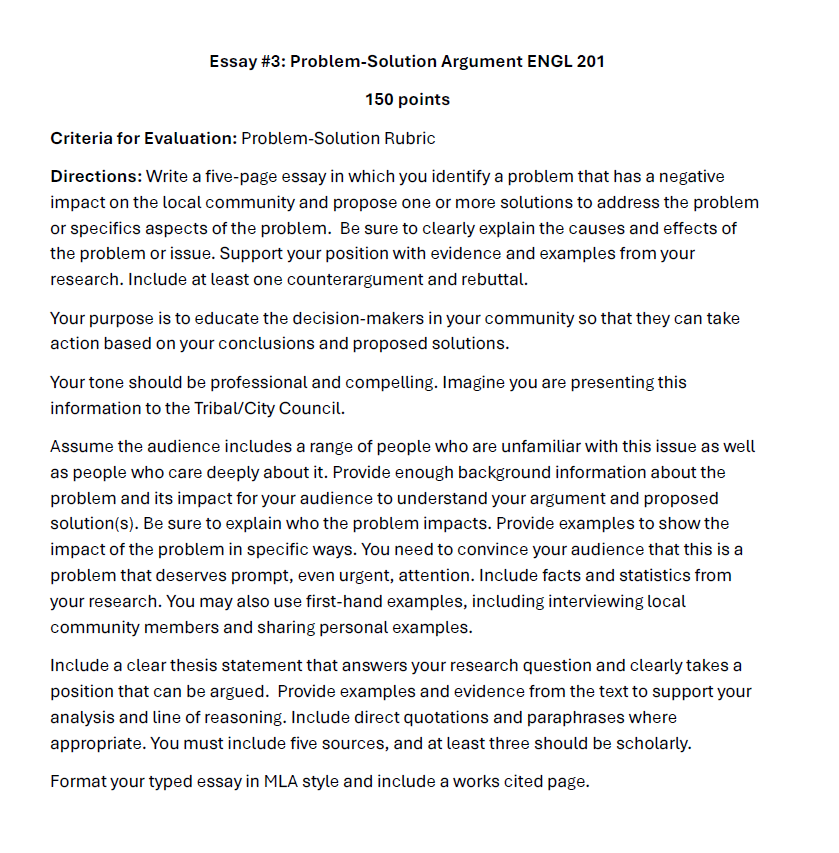
After a successful unit focused on rhetorical analysis with a heavy emphasis on supporting analysis with textual evidence, my students and I turned our focus to problem-solution argumentative writing. The expectation was to draft a five-page paper focused on the research question in accordance with the assignment instructions (see Appendix A).
I encouraged students to consider problems that were issues in their local community, and that local decision-makers could impact, such as a local City or Tribal Council. I assigned students to choose a topic that does not have a simple solution and that they care strongly about. Examples of topics intentionally included areas of identity reclaiming and cultural pride. I also challenged them to keep local governing bodies in mind as the intended audience, with the option to present their final product for community improvement.
As part of the prewriting process, we brainstormed topics using a graphic organizer that used four categories: problems facing my community; problems related to well-being; problems related to morals/values/beliefs; problems with long-term impact.
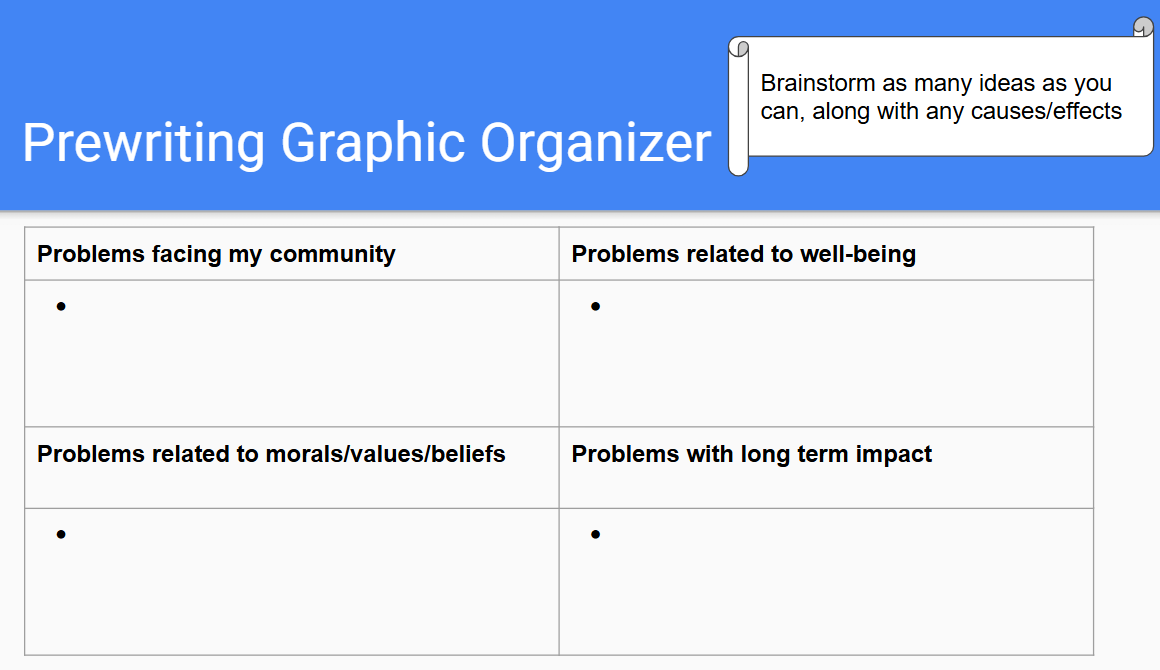
Figure 1: Slide from lecture: Prewriting graphic organizer.
After brainstorming ideas, students were then supposed to pick a topic and then narrow the topic down to a manageable size. I used a previously taught strategy for zooming in or out (see figure 2).
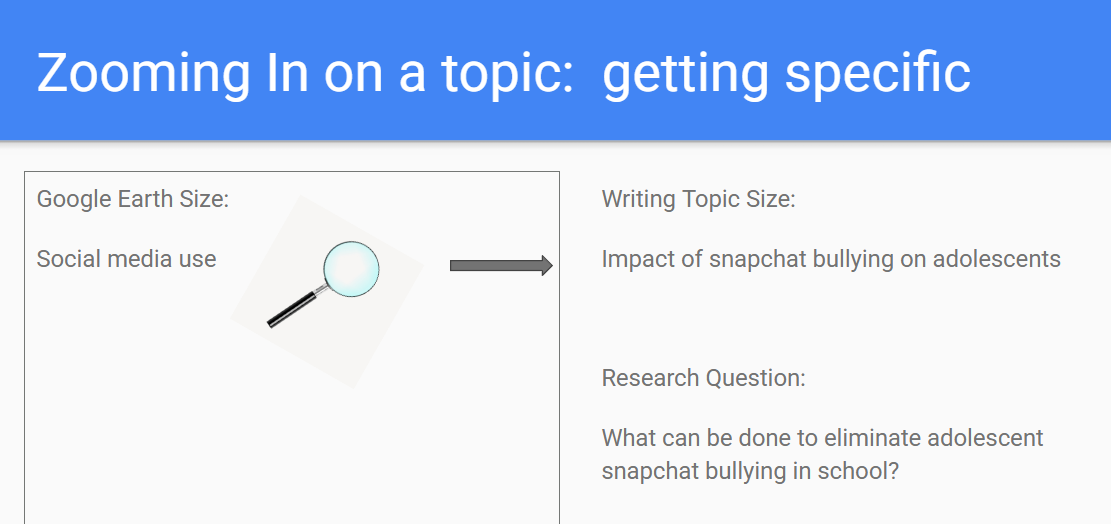
Figure 2: Zooming in.
Then, students were given question stems to turn their topic into a research question. These structured question stems provide scaffolding for students to convert their topic into a question by using one of three templates (see figure 3). Students also learned about the purpose and process of creating search terms and tried them out in the library database. I walked through the purpose and process of skimming academic articles to determine if an article is something worth reading closely in the future, focusing on peer-reviewed research. I also modeled how to take notes and provided a note-taking template to keep track of learning from various sources.
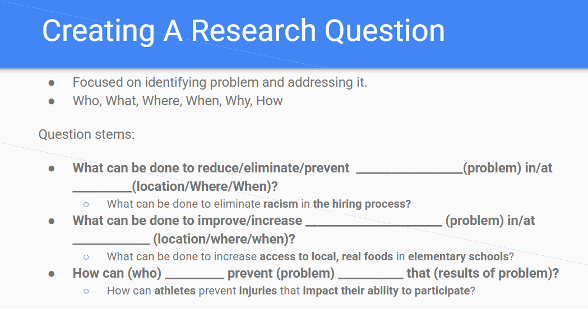
Figure 3: Question stems.
I also provided a sample outline for the structure of their argument, which included a paragraph for counterargument. When I went over the purpose and content of the outline, I emphasized the importance of considering alternate points of view, including what someone who opposed your proposed solution(s) might say. Counterargument is part of the Minnesota English Language Arts (ELA) standards and grade level benchmarks for grades 6-12. Because of this, I believed my students were familiar with counterarguments. I also used related vocabulary such as counterclaim and rebuttal in case they were more familiar with this terminology.

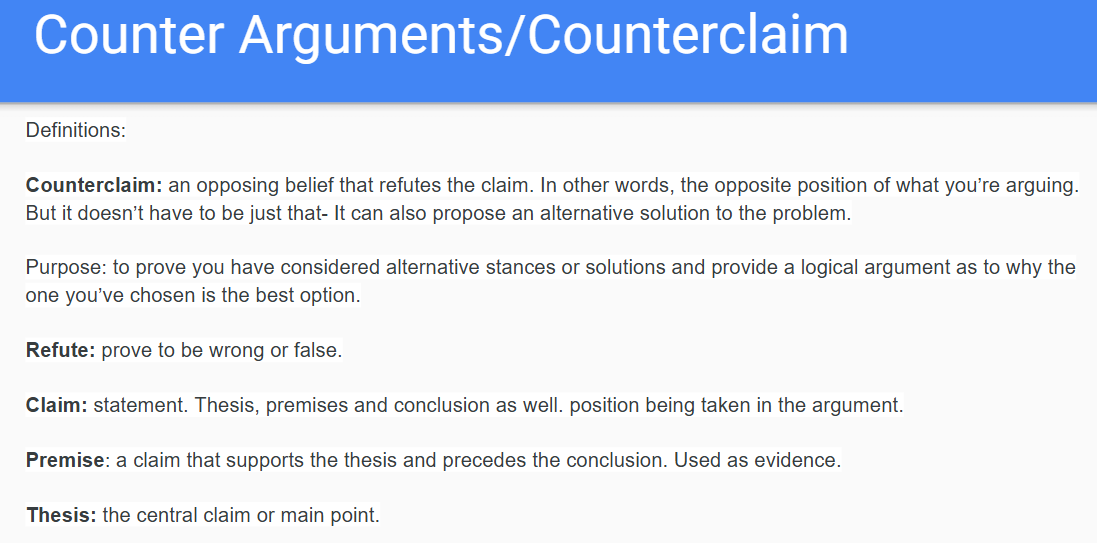
Figure 4: Counterarguments.
The Learning Problem
However, when students turned in their initial rough drafts, not one of them included a counterargument paragraph. I even went back to check that this was an explicit expectation, since this is overall a very motivated group of students. When I reflected on how I had included it, I realized that I had really done little more than define the term and then assign it. I had not taught the students how to identify an opposing viewpoint, how to think through why someone might legitimately think this way, or how to craft the paragraph. I had not even shown them an example. Because argumentative writing has been part of the state standards for 15 years, I mistakenly assumed it was prior knowledge for students. I realized this was, at least partly, a “me problem.” Big oops.
The Unfolding Events
Before reteaching counterargument, I researched available strategies and content online and was overall disappointed with the quality and quantity of resources available. While I found many argumentative resources, little time was spent focusing on counterclaim or rebuttal and simply focused on defining the terms, giving an example, and providing a sentence starter.
Since the class had already turned in their first rough drafts, the next class lecture focused on revision for counterargument.
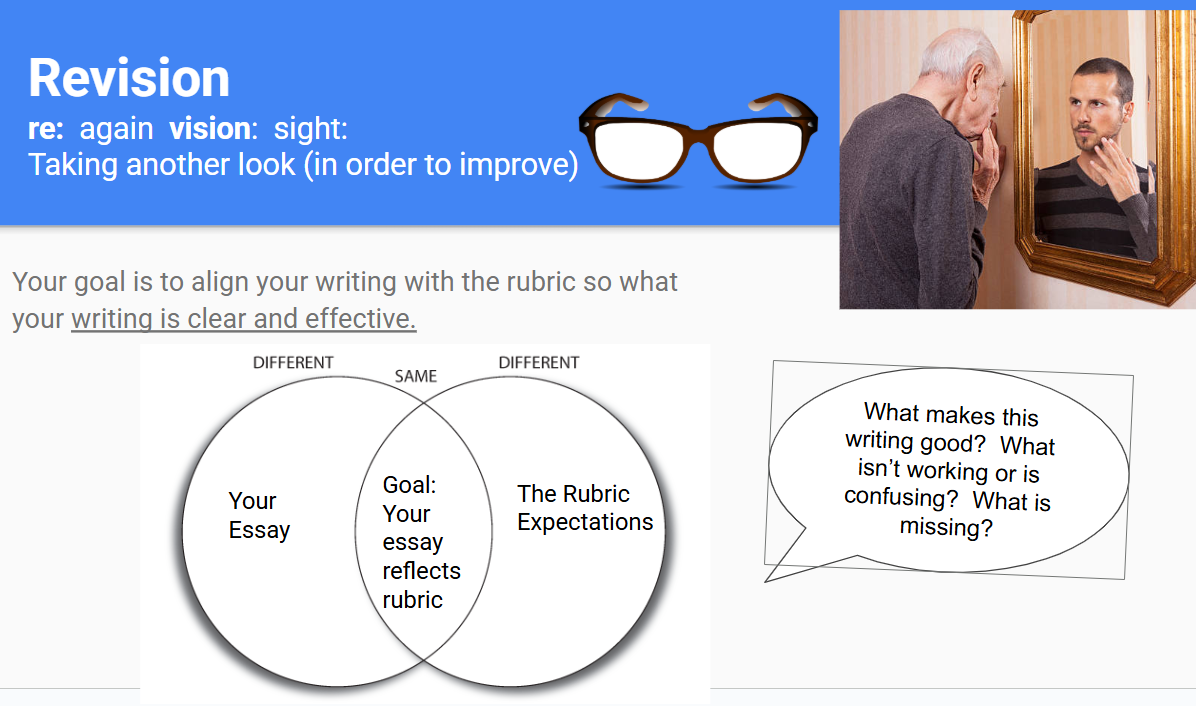
Figure 5: Revision.
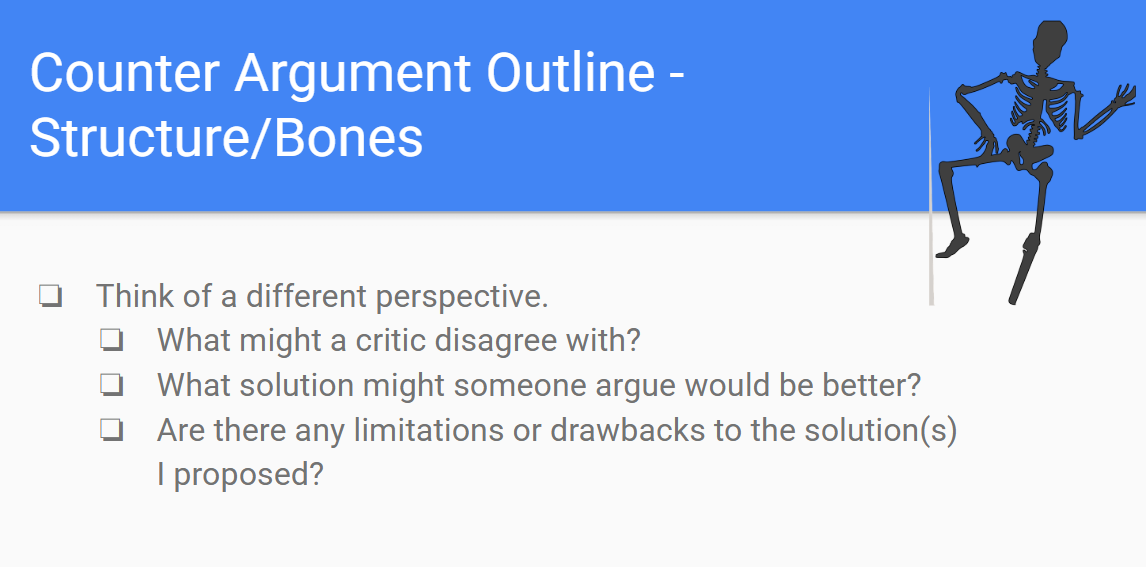
Figure 6: Counterargument outline questions.
I talked through the components of a counterargument, how it functions within the argument, and how to step into the shoes of someone who thinks differently than you.
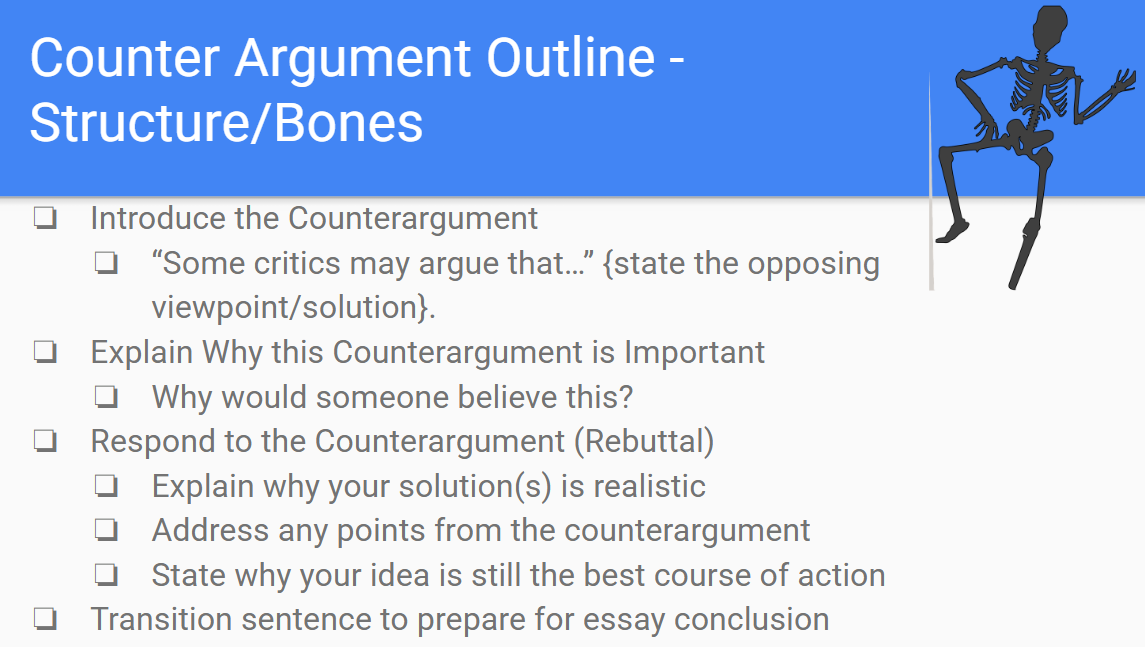
Figure 7: Counterargument outline structure.
During this lesson, I included how to use Chat GPT as a thought partner (not author) for identifying counterarguments for their topic, since most of them seemed to assume there were no other logical positions on their topic. I demonstrated how to prompt ChatGPT and used the initial prompt: what are some potential counterarguments for the argument that social media bullying by adolescents is a serious problem? I shared that this gave me some general criticism but was not specific enough for my focus on anti-bullying strategies that require student involvement to really get me thinking. I then provided another prompt: refine the counterargument, focusing on criticizing a strategy that relies on student intervention. As part of my think aloud, I shared that this started me thinking about who might have these concerns—that immediately, parents, teachers, and students came to mind. I had different perspectives to consider. From there, the “why” came to me naturally.
I then modeled using the paragraph template to create a paragraph as an example. Talking through the example, I highlighted specific language that related to each part of the counterargument and rebuttal. See Figure 8 below.
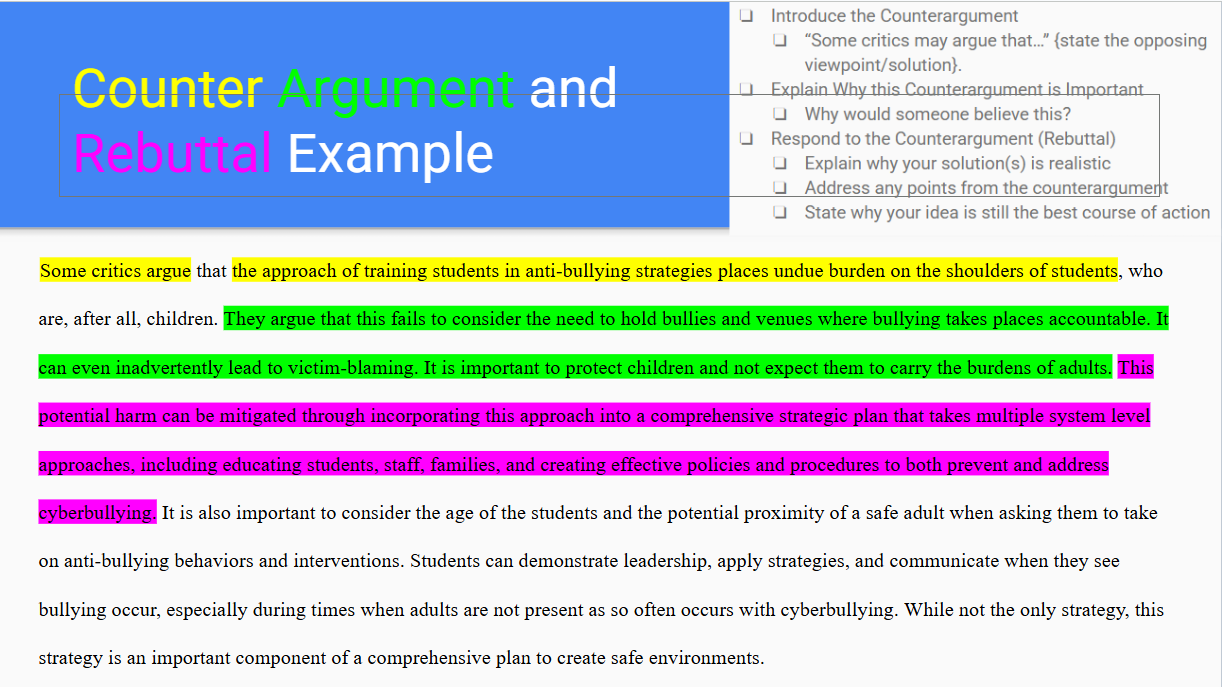
Figure 8: Counterargument and rebuttal example.
At the end of the lesson, students were assigned the task of revising their papers to include a counterargument with rebuttal.
Evidence of Learning
In rough draft #2, every paper turned in now contained a counterargument. That was progress, I thought. Then, I examined the content of their counterarguments. As I read, they seemed too perfect. I ran them through a plagiarism checker, and they came out clean. I could not believe it; was it this easy?
When listening to students interacting in small groups to discuss their essays and get feedback, it sounded like they had a better understanding of the idea of a counterargument in that they were able to identify them in a classmate’s paper. There were also expressions of how hard it was to think about what someone who disagrees might say, because why would anyone think differently? That was revealing. Given this information, it sounded like students over-relied on AI when it came to either writing and/or revising their counterarguments.
Reflections
At the heart of teaching is the practice of reflection. Much like a detective, a reflective teacher must set aside frustration and disappointment and instead ask questions to gain information, looking for clues to understand what occurred and why. In short, this is a case of assumptions, failure to assess prior knowledge, and inadequate scaffolding.
I began with unfounded assumptions regarding student proficiency with ChatGPT and critical thinking. Students need to understand the purpose behind a tool before they can use it with finesse. I began to suspect that I had inadvertently led students to over-rely on ChatGPT as a thought partner before assessing their readiness to consider alternative perspectives. This is evidenced in their over-reliance to use it in drafting/refining. Before jumping to ChatGPT, I should have assessed prior knowledge around the ability to consider diverse perspectives. The ability to consider a point of view other than one’s own is crucial for critical thinking and problem-solving, and interpersonal relationships. Additionally, I should have provided more guidance around the specific uses of ChatGPT and not moved to an assistive tool until students demonstrated the prerequisite content area skills first. Additionally, I could have provided a more scaffolded experience when using ChatGPT by separating the steps of gaining possible counterclaim ideas from evaluating them and incorporating them into the essay.
While I clarified the purpose and content of a counterclaim and I modeled the development of one, I failed to sufficiently scaffold the processes in between. I assumed they could limit their use of ChatGPT to thought partner, and I thought they could identify and consider other perspectives without evidence of them showing the possession of the skills. These subskills implied in the construction of a counterclaim and rebuttal were still needed. They demonstrated the ability to identify a counterargument during their discussions. Upon reflection, I still fell prey to the allure of presumption.
When I reteach counterargument, I will first spend some time teaching perspective taking, using movement to reinforce the idea of changing points of view. We will spend more time examining perspective taking, using a four corners activity where we can experience hearing multiple perspectives on a topic and have the opportunity to shift our thinking based on the ideas of others. I would also provide a graphic organizer to help students capture important information to notice from the counterargument examples and then use the same graphic organizer as a prewriting tool for their own future counterclaim development. I will also cut apart an example argumentative essay and have students put it together, justifying their placement paragraphs/sentence along with what evidence led them to their decision.
Case Analysis
Looking back at the case narrative, it is not surprising that this set of lessons unfolded the way they did. Although I had taught similar units before, they were at a less rigorous level. This was the first time I had taught this course and was teaching half-time on top of another full-time job, which limited the amount of preparation time available and consequently, also limited my ability to engage in reflective practice. The format of the course was an experiment also; instead of meeting online Tuesday and Thursdays, the course met on Thursdays online and then was asynchronous for the rest of the week. This was a challenge for both students and me to figure out how to best approach the course content. Many of the students were in their first or second online course, and the college was transitioning from Zoom to Microsoft Teams, so there was an added challenge of learning the technology features. Additionally, after midterms, participation tends to drop significantly as students start looking towards the end of the semester and burnout starts to set in. Student attendance dropped by about half during any given class period, resulting in lots of gaps in student understanding, and frustrations when trying to catch up. This also contributed to the learning challenges.
Assessing Prior Knowledge
I assessed prior knowledge through a course pre-assessment as the first assignment of the course. According to Jockett and Doubet, “Effective pre-assessments can illuminate where students are now so that teachers can lead them to mastery” (50). The course pre-assessment included stating a claim and citing relevant and sufficient evidence from a provided text set. The format was a multi-paragraph essay with an introduction, supporting paragraphs, and a conclusion. While these were important goals of the unit, it did not include a counterargument or considering alternative points of view on the topic. This pre-assessment occurred 8 weeks before the argument unit. To be effective, pre-assessments need to be given just before the teaching occurs, so they are not outdated and should be focused on what all students will be expected to do and kept brief (51). I initially reviewed the pre-assessment results to inform my lesson design, but at the time I did not notice the absence of the counterargument or consider the length of time that had already passed. A more useful and accessible way to assess prior knowledge might have been asking students to generate several possible points of view on a topic with support for each point of view.
I did not assess prior knowledge of ChatGPT before expecting students to use it, assuming that it was self-explanatory. I jumped to include a shiny new tool before carefully considering it. This resulted in students allowing ChatGPT to do the thinking for them, instead of engaging as a thought partner and staying in control of their thinking. Before asking students to use ChatGPT for something like this in the future, I would have them engage in point of view development activities and also model how to sort through and make sense of the ideas presented by ChatGPT. A recent study related to evaluating ChatGPT’s role in English course implementation reported that participants reported concerns that “reliance on ChatGPT might diminish fundamental writing skills” (Avsheniuk et al. 217). This study identified grammar-related benefits and benefits related to some types of cognitive skills but further emphasized its role as a “supplementary aid rather than a standalone solution” (217). Before using it in this way in the future, I would develop a guided activity that prompts evaluation of the answers provided by ChatGPT. I would also teach students specifically how I want them to use the tool for this assignment, acknowledging there are many ways to use the tool.
Mentor Texts
This case initially suffered from a lack of argumentative mentor texts to support student learning. Mentor texts are examples of strong writing that students can refer to throughout the writing process (Thompson and Reed). A mentor text can help students conceptualize new, challenging tasks thereby making them more tangible. With prompting, students can identify traits of the mentor text, reveal insight about the target genre. Further, it is important that students understand how the author constructs the mentor text. What is the process? What are the components? I assumed students knew what I was looking for based on a few definitions and no examples.
When I realized this, I tried to expedite this process by intentionally thinking aloud, allowing my thoughts about developing the writing to be heard by students during the lesson along with the mentor text. In this way, they got to see how I developed my text and why. Also, by including a counterargument and rebuttal outline with sentence starters, students had access to the underlying structure that was informing how I wrote. As this intervention resulted in students successfully writing counterarguments with rebuttals, it proved effective. Additional guided practice to improve the scaffolding may have resulted in increased participation since some students still did not turn in a draft.
According to author and secondary ELA educator Kelly Gallagher, “Having students recognize good writers’ techniques positions them to infuse them into their own compositions” (29). Mentor texts can serve as a revision tool when students can notice how their writing differs. I used my own writing as a mentor text during the counterargument revision lesson. In the future, I will ensure students have access to multiple mentor texts from the start of the unit—a practice I usually do.
Scaffolding
Scaffolding and gradual release are the tools teachers use to help students achieve what they would not be able to do on their own. This scaffolding and situated learning has an effective size of .52 and has the potential to accelerate student learning (Hattie 380). This meta-analysis is directly in line with Vygotsky’s theory of the Zone of Proximal Development that acknowledges the gap between what students can do independently and what they can do with the support of guided instruction (Hattie). The reteaching included direct instruction, modeling of thinking aloud, and an annotated example mentor text which are all types of effective scaffolds. This explains why student participation dramatically increased following this intervention, and every rough drafted turned in contained a counterargument. This was a successful move.
However, there was insufficient gradual release of the scaffolding into independent writing. Instead of guided practice, I moved them to independent practice, which had mixed results as far as quality and led to overreliance on ChatGPT. One of the challenges of implementation was timing and course format. This lesson occurred during the asynchronous portion of the week, and I was limited by my ability to create interactive lessons using the available technology. A stronger approach would include gradual release based on student confidence and capacity with the material at increasing levels of independence—something that can be addressed in the future. A guided activity while utilizing ChatGPT would have also served as an important piece of scaffolding to bolster student success and critical thinking.
Implications
In the words of Benjamin Franklin, “Failing to plan is planning to fail.” While I did plan many aspects of the learning progression for the argument unit and students learned a great deal overall, learning could have been accelerated by careful preplanning and scaffolding in place from the onset of the unit related to counterargument. This case study reinforces the importance of assessing prior knowledge, carefully-planning units with end goals in mind, and intentionally providing scaffolding to help students move towards independence on key skills. It also reinforces the importance of mentor texts for providing concrete examples of writing and genre expectations. Examples make the abstract concrete and provide important details and nuances that are often absent in assignment directions or rubrics. The importance of taking the time to backwards plan a unit is vital. Many of the issues I encountered and then had to work twice as hard to try to fix were the direct result of failing to effectively plan with the end in mind before the unit started. I did not use a curriculum unit template or planning tool—despite being someone who should know better. Planning a unit with the end in mind supported by carefully scaffolding learning experiences developed based on timely and strategic assessment of prior knowledge is a powerful strategy to meet the needs of the students in front of you.
Additionally, this case contributes to the idea that counterarguments are more than just a component of an argument. The ability to create counterarguments relies on critical thinking skills—including the ability to anticipate and address audience needs as well as the ability to thoughtfully identify and consider alternate perspectives.
This case also highlights the need to review vertical alignment of ELA standards related to perspective taking and writing counterarguments. More broadly, this case emphasizes the need for stronger alignment between secondary and postsecondary courses in their approach to teaching counterarguments and its connection to perspective taking.
Conclusion
This case study started with a missing counterargument but ultimately revealed a skill gap in perspective taking as well. I love teaching this particular genre because of the high level of student investment and sense of autonomy and authenticity for students. Overall, students are well prepared to do the bulk of the work and thoughtfully propose solutions for local community problems. This is evidenced in their sustained enthusiasm for their chosen topics, belief that they are learning skills that prepare them for future careers, and desire to share their work with others. However, future students will benefit from this case analysis in that I will assess prior knowledge specifically on counterarguments and the ability to think through multiple points of view before teaching them.
I will also intentionally provide scaffolded experiences for students to develop their ability to consider diverse perspectives and identify and analyses counterarguments before being asked to write one. Students struggled to use AI as a thought partner, and instead over relied on it, further revealing the learning gap, reinforcing the need for a scaffolded experience. More than just a component of argument, the counterargument was recognized as the convergence of critical thinking, reasoning, and taking multiple perspectives, elevating it to an essential skill not only for academia, but for civic and professional life.
Ultimately, this case emphasizes the vital importance of reflective practice. By resisting the temptation to give into frustration and deflection, I was able to play the detective and get curious about what was missing beneath the surface in my instruction. Self-reflection often reveals many opportunities to improve our own practice and reinforces the important, yet uncomfortable reminder that student learning reflects the effectiveness of our instruction. As teachers, it is difficult to stop and take the time to reflect when juggling numerous responsibilities. Carefully reviewing my instructional strategies and resources along with evidence of student learning allowed me to more fully understand how my actions impacted the learning experience and how I might more effectively support learning in the future.
More research is needed on effective instructional strategies for developing student capacity in developing and evaluating counterclaims. While I did this reflection on my own, there is a need to partner with other instructors engaging in similar work for mutual support. A vertical professional learning community opportunity around counterarguments and perspective taking would be a practical next step.
Works Cited
“About College A.” College A, www.collegea.edu/about/. Accessed 17 November 2025.
Avsheniuk, N., et al. “Empowering language learners’ critical thinking: Evaluating ChatGPT’s role in English course implementation.” Arab World English Journal, 1(1), 2024, pp. 210–224. doi.org/10.24093/awej/ChatGPT.14
Bryan-Gooden, J., M. Hester, and L. Q. Peoples. Culturally responsive ELA curriculum scorecard. Metropolitan Center for Research on Equity and the Transformation of Schools, New York University, 2023.
Gallagher, K. “Making the most of mentor texts.” Educational Leadership, 71(7), 2014, pp. 28-33.
Hattie, John. Visible learning: the sequel: A synthesis of over 2,100 meta-analyses relating to achievement. Routledge, 2023. Doi.org/10.4324/9781003380542
Hockett, J. A. et al. “Turning on the lights: What pre-assessments can do.” Educational Leadership, 71(4), 2013, pp. 50–54.
“Home.” College A. www.collegea.edu/. Accessed 20 November 2025.
Thompson, S., and Deborah K. Reed. “Using mentor texts to learn from the best and improve students’ writing.” Iowa Reading Research Center – The University of Iowa. irrc.education.uiowa.edu/blog/2019/01/using-mentor-texts-learn-best-and-improve-students-writing Accessed 22 January 2019.
Appendix A
Learn more about the author on our 2026 Contributors page.